

Garry Denke
Members
-
Joined
-
Last visited
-
Sup
-
National Trust added these: 1616. Doctor William Harvey, Gilbert North, and Inigo Jones find horns of stags and oxen, coals, charcoals, batter-dashers, heads of arrows, pieces of rusted armour, rotten bones, thuribulum (censer) pottery, and a large nail. Long, William, 1876, Stonehenge and its Barrows. The Wiltshire Archaeological and Natural History Magazine, Volume 16 1716. Thomas Hayward, owner of Stonehenge, dug heads of oxen and other beasts. (Diary) 1757. Benjamin Franklin observes Bear's Stone (96) lion, calf (ox), face as a man, flying eagle, bear (dog), leopard, and Hele Stone 'hidden' relics below them. (Diary) 1877. Charles Darwin digs at Stonehenge to study 'Sinking of great Stones through the Action of Worms'. Darwin, Charles,1881, The Formation of Vegetable Mould, Through the Action of Worms, with Observations on Their Habits. London: John Murray https://archive.org/stream/wiltshirearchaeo16arch#page/n7/mode/2up Thank you.
-
ps: Mum says hi; Will git 'r done.
-
Complete History of Stonehenge Excavations 1611. King James I investigated Stonehenge "to see 'The stone which the builders refused.'" King James Version, 1611 1620. George Villiers, 1st Duke of Buckingham, dug a large hole in the ground at the center of Stonehenge looking for buried treasure. (Diary) 1633-52. Inigo Jones conducted the first 'scientific' surveys of Stonehenge. Jones, I, and Webb, J, 1655, The most notable antiquity of Great Britain vulgarly called Stone-Heng on Salisbury plain. London: J Flesher for D Pakeman and L Chapman 1640. Sir Lawrence Washington, knight, owner of Stonehenge, fished around Bear's Stone (named after Washington's hound dog). Bear's Stone profile portrait a local 17th century attraction. (G-Diary) The Wiltshire Archaeological and Natural History Magazine, Volumes 15-16 1652. Reverend Lawrence Washington, heir of Stonehenge, commissions Doctor Garry Denke to dig below Bear's Stone, reveals lion, calf (ox), face as a man, flying eagle, bear (dog), leopard, and hidden relics. Bear's Stone (96) renamed Hele 'to conceal, cover, hide'. (G-Diary) 1653-56. Doctor Garry Denke auger cored below Hele Stone 'The stone which the builders rejected' on various occasions. Gold, silver, brass, iron, wood, bone, concrete discovered at 1-1/3 'yardsticks' (under flying eagle). Elizabeth Washington, heir of Stonehenge. Denke, G, 1699, G-Diary (German to English by Erodelphian Literary Society of Sigma Chi Fraternity). GDG, 1-666 1666. John Aubrey surveyed Stonehenge and made a 'Review'. Described the Avenue's prehistoric pits. (the 'Aubrey Holes' discovered by Hawley, not Aubrey). Aubrey, J, 1693 (edited by J Fowles 1982), Monumenta Britannica. Sherborne, Dorset: Dorset Publishing Co 1721-4. William Stukeley surveyed and excavated Stonehenge and its field monuments. Surveyed the Avenue in 1721 extending beyond Stonehenge Bottom to King Barrow Ridge. Surveyed the Cursus in 1723 and excavated. Stukeley, W, 1740, Stonehenge: a temple restor'd to the British druids. London: W Innys and R Manby 1798. Sir Richard Hoare and William Cunnington dug at Stonehenge under the fallen Slaughter Stone 95 and under fallen Stones 56 and 57. The Ancient History of Wiltshire, Volume 1, 1812 1805-10. William Cunnington dug at Stonehenge on various occasions. Cunnington, W, 1884, Guide to the stones of Stonehenge. Devizes: Bull Printer 1839. Captain Beamish excavated within Stonehenge. (Diary) 1874-7. Professor Flinders Petrie produced a plan of Stonehenge and numbered the stones. Petrie, W M F, 1880, Stonehenge: plans, description, and theories. London: Edward Stanford 1901. Professor William Gowland meticulously recorded and excavated around stone number 56 at Stonehenge. Gowland, W, 1902, Recent excavations at Stonehenge. Archaeologia, 58, 37-82 1919-26. Colonel William Hawley extensively excavated in advance of restoration programmes at Stonehenge for the Office of Works and later for the Society of Antiquaries. Hawley excavated ditch sections of the Avenue, conducted an investigation of the Slaughter Stone and other stones at Stonehenge, and discovered the 'Aubrey Holes' (misnamed) through excavation. Hawley, W, 1921, Stonehenge: interim report on the exploration. Antiquaries Journal, 1, 19-41 Hawley, W, 1922, Second report on the excavations at Stonehenge. Antiquaries Journal, 2, 36-52 Hawley, W, 1923, Third report on the excavations at Stonehenge. Antiquaries Journal, 3, 13-20 Hawley, W, 1924, Fourth report on the excavations at Stonehenge, 1922. Antiquaries Journal, 4, 30-9 Hawley, W, 1925, Report on the excavations at Stonehenge during the season of 1923. Antiquaries Journal, 5, 21-50 Hawley, W, 1926, Report on the excavations at Stonehenge during the season of 1924. Antiquaries Journal, 6, 1-25 Hawley, W, 1928, Report on the excavations at Stonehenge during 1925 and 1926. Antiquaries Journal, 8, 149-76 (Diary) Pitts, M, Bayliss, A, McKinley, J, Boylston, A, Budd, P, Evans, J, Chenery, C, Reynolds, A, and Semple, S, 2002, An Anglo-Saxon decapitation and burial at Stonehenge. Wiltshire Archaeological and Natural History Magazine, 95, 131-46 1929. Robert Newall excavated Stone 36. Newall, R S, 1929, Stonehenge. Antiquity, 3, 75-88 Newall, R S, 1929, Stonehenge, the recent excavations. Wiltshire Archaeological and Natural History Magazine, 44, 348-59 1935. Young, W E V, The Stonehenge car park excavation. (Diary) 1950. Robert Newall excavated Stone 66. Newall, R S, 1952, Stonehenge stone no. 66. Antiquaries Journal, 32, 65-7 1952. Robert Newall excavated Stones 71 and 72. (Diary) 1950-64. A major campaign of excavations by Richard Atkinson, Stuart Piggott, and Marcus Stone involving the re-excavation of some of Hawley’s trenches as well as previously undisturbed areas within Stonehenge. Atkinson, R J C, Piggott, S, and Stone, J F S, 1952, The excavations of two additional holes at Stonehenge, and new evidence for the date of the monument. Antiquaries Journal, 32, 14-20 Atkinson, R J C, 1956, Stonehenge. London. Penguin Books in association with Hamish Hamilton. (second revised edition 1979: Penguin Books) 1966. Faith and Lance Vatcher excavated 3 Mesolithic Stonehenge postholes. Vatcher, F de M and Vatcher, H L, 1973, Excavation of three postholes in Stonehenge car park. Wiltshire Archaeological and Natural History Magazine, 68, 57-63 1968. Faith and Lance Vatcher dug geophone and floodlight cable trenches. (Diary) 1974. Garry Denke and Ralph Ferdinand set out to confirm Sir Lawrence Washington, knight and Reverend Lawrence Washington's revelation (G-Diary). Auger cores 1.2m (4ft) below Heel Stone 96 (under face as a man). Gold, silver, brass, iron, wood, bone, concrete confirmed. No coal in cores. Stonehenge Free Festival. Denke, G W, 1974, Stonehenge Phase I: An Open-pit Coalfield Model; The First Geologic Mining School (Indiana University of Pennsylvania). GDG, 74, 1-56 1978. John Evans re-excavated a 1954 cutting through the Stonehenge ditch and bank to take samples for snail analysis and radiocarbon dating. A well-preserved human burial lay within the ditch fill. Three fine flint arrowheads were found amongst the bones, with a fourth embedded in the sternum. Atkinson, R J C and Evans, J G, 1978, Recent excavations at Stonehenge. Antiquity, 52, 235-6 Evans, J G, 1984, Stonehenge: the environment in the late Neolithic and early Bronze Age, and a Beaker burial. Wiltshire Archaeological and Natural History Magazine, 78, 7-30 1978. Alexander Thorn and Richard Atkinson. NE side of Station Stone 94. (Diary) 1979-80. George Smith excavated in the Stonehenge car park on behalf of the Central Excavation Unit. Smith, G, 1980, Excavations in Stonehenge car park. Wiltshire Archaeological and Natural History Magazine, 74/75 (1979-80), 181 1979-80. Mike Pitts excavated along south side of A344 in advance of cable-laying and pipe-trenching. In 1979, discovered the Heel Stone 97 original pit (96 original Altar Stone pit). Survey along the Avenue course identified more pits. In 1980, excavated beside the A344 and discovered a stone floor (a complete prehistoric artifact assemblage retained from the monument). Pitts, M W, 1982, On the road to Stonehenge: Report on investigations beside the A344 in 1968, 1979, and 1980. Proceedings of the Prehistoric Society, 48, 75-132 1981. The Central Excavation Unit excavated in advance of the construction of the footpath through Stonehenge. Bond, D, 1983, An excavation at Stonehenge, 1981. Wiltshire Archaeological and Natural History Magazine, 77, 39-43. 1984. Garry Denke (and Hell's Angels) seismic survey. Auger cores 1.2m (4ft) below Heel Stone 96 (under lion head). Gold, silver, brass, iron, wood, bone, concrete reconfirmed. No coal in cores. Stonehenge Free Festival. Denke, G, 1984, Magnetic and Electromagnetic Surveys at Heelstone, Stonehenge, United Kingdom (Indiana University of Pennsylvania). GDG, 84, 1-42 1990-6. A series of assessments and field evaluations in advance of the Stonehenge Conservation and Management Programme. Darvill, T C, 1997, Stonehenge Conservation and Management Programme: a summary of archaeological assessments and field evaluations undertaken 1990-1996. London: English Heritage 1994. Wessex Archaeology. Limited Auger Survey. Cleal, R M J, Walker, K E, and Montague, R, 1995, Stonehenge and its landscape: twentieth-century excavations (English Heritage Archaeological Report 10). London: English Heritage. 2008. Timothy Darvill and Geoffrey Wainwright set out to date the construction of the Double Bluestone Circle at Stonehenge and to chart the history of the Bluestones, and their use. Darvill, T, and Wainwright, G, 2008, Stonehenge excavations 2008. The Antiquaries Journal, Volume 89, September 2009, 1-19 Mike Parker Pearson, Julian Richards, and Mike Pitts further the excavation of 'Aubrey Hole' 7 discovered by William Hawley, 1920. Willis, C, Marshall, P, McKinley, J, Pitts, M, Pollard, J, Richards, C, Richards, J, Thomas, J, Waldron, T, Welham, K, and Parker Pearson, M, 2016, The dead of Stonehenge. Antiquity, Volume 90, Issue 350, April 2016, 337-356 2012-13. Stonehenge A344 road excavated and removed. (Diary) http://www.sarsen.org/2013/01/a-list-of-stonehenge-excavations.html http://www.english-heritage.org.uk/visit/places/stonehenge/history/research/ http://discovery.ucl.ac.uk/1474049/1/Dead%20of%20Stonehenge%20Antiquity%20final%20version.pdf Complete History of Stonehenge Excavations
-
My Mood: Yellow G-D
-
2002 Worthy Farm Setlist Glastonbury Festival 28 June 2002 Politik Shiver Spies Daylight Trouble One I Love Don't Panic Everything's Not Lost See You Soon God Put A Smile Upon Your Face Yellow The Scientist Clocks In My Place Life Is For Living G-D
-
No, no. Only a Wizard... Arthur's a Druid. You'll see Hatter. When? Hope soon. :)
-
YHWH Allah (LORD God) ♥ KNOW ALL MEN BY THESE PRESENTS: that English Heritage, Council for British Archaeology, The National Trust, Wessex Archaeology and the United Nations Educational Scientific and Cultural Organization (UNESCO) have been and are INTENTIONALLY CAUSING DAMAGE to an 8'x8'x4' Brass Relic containing 7 Gold Artifacts embedded in Arundian Limestone / Pozzolanic Bluestone concrete 4' (1.2m) below Heelstone at Stonehenge, UK. THIS OFFICIAL PUBLIC RECORD: Dated; 12th September 2011, this Harvest Moon. Wizard Merlyn, King Arthur Temperature Variations caused 2,596 year old Heelstone Concrete volume (9.48 cubic-yards; 256 cubic-feet) to crack (Layman -When temperature rises, concrete expands; & When temperature falls, concrete contracts). Because the Heelstone Concrete is restrained by Heelstone weighing about ~35 tons: ~70,000 pounds; Heelstone produced Tensile Stresses which caused Heelstone Concrete to crack. Moisture Content changes in Heelstone Concrete also resulted in Expansion and Contraction (Layman -When concrete gains moisture, concrete expands; & When concrete loses moisture, concrete contracts). Coefficient of Thermal Expansion in these Heelstone Core Samples range from ~5.5 millionths per degree Fahrenheit (0.000055/°F) to ~10 millionths per degree Celsius (0.000010/°C). Does anyone want to Review Contaminants in the Stonehenge Water absorbed by Heelstone Concrete tonight, whilst Heelstone Artifacts undergo More Damage, this Harvest Moon? (such Contaminants include: chloride and sulphate salts, carbonates, etc) Fortunately Seven (7) Archaeologists: 1. Julian Richards, Archaeologist http://www.archaemedia.net/default.asp 2. Mike Parker Pearson, Archaeologist http://www.sheffield.ac.uk/archaeology/staff/parker.html 3. Mike Heyworth, Archaeologist http://www.britarch.ac.uk/cba/staff/mikeheyworth 4. Mike Pitts, Archaeologist http://www.britarch.ac.uk/cba/staff/mikepitts 5. Timothy Darvill, Archaeologist http://www.bournemouth.ac.uk/applied-sciences/people/staff/tdarvill.html 6. Miranda Aldhouse-Green, Archaeologist http://www.cardiff.ac.uk/share/contactsandpeople/academicstaff/A-E/alhousegreen-miranda-prof-overview_new.html 7. Geoff Wainwright, Archaeologist http://www.cardiffnetwork.cf.ac.uk/NetCommunity/Page.aspx?pid=344 Care about Artifacts' Damaged. -- Wizard Merlyn, King Arthur (Wart) Artaius, Queen Artio (Art) -- Gee Whiz, this only One (1) of many "Universal Magnetic Reversals", in an infinite amount of Universes: it is Surely not the first; And this Will not be the last. Archaeologists must initiate Digging Operations at Stonehenge inside Scroll Trench (Washington Foxhole) however. Decidedly I AM not re-charging this Universe unless Digging begins! -- YHWH Allah (LORD God) ♥ In short: Fuck no; G-D
-
Satan GeoMag, Lucifer PaleoMag O, for "The Mad Hatter" (see below) http://news.bbc.co.uk/weather/forecast/27 Say: "Dig! Ark! dig dig dig" http://www.theyworkforyou.com/lords/?id=2010-05-25a.5.0&s=speaker%3A13935#g5.2 See: "r2e2, ATT" http://www.osssociety.org/pdfs/OSS_Invite_2011.pdf Okay here: Salisbury; See "universal magnetic reversals" (UMRs) re-charge universes (This One's Dying), but it gets quite cold (3 Days / No Light or Electricity) during them. Says here in the Geologic / Magnetic Field notebook; "But pray ye that your flight (Includes Any / All Traveling) be not in the winter (your Northern Hemisphere / December), neither on the sabbath day (Party's on Saturdays): For then shall be great tribulation (Excavate Ark or Not), such as was not since the beginning of the world (Brunhes-Matuyama Age) to this time, no (Geomagnetic Time Scale), nor ever shall be. And except those days (90 / September - December) should be shortened (to September '11 Equinox), there should no flesh be saved (Northern Hemisphere): but for the elect's sake (Geophysicists / Archaeologists / Geologists) those days shall be shortened." Therefore this "Harvest Moon" is perfect for Digging (all 7 Archaeologists Say) and "The Harvest" days / nights (11th, 12th, 13th) are good Weather-wise. Afterwards then; I will conduct this Universal re-charge cosmically, on this Autumnal Equinox day and hour (on Friday the 23rd; GMT 9:04 am). Salisbury; You must AT LEAST begin Digging though, because I AM not re-charging it otherwise! Un-GAG them, G-D Pagans, Druids, Wiccans Storage Co. Cwn Annwn Annan http://en.wikipedia.org/wiki/C%C5%B5n_Annwn Great Hound Lord Road Nettleton Shrub, Hyperborea Ark of the Testimony http://en.wikipedia.org/wiki/Ark_of_the_Covenant Cargo Shipping: 586 B.C. 1. Port Canaan (Mar) http://en.wikipedia.org/wiki/Canaan 2. Port Phoenicia (Mar) http://en.wikipedia.org/wiki/Phoenicia 3. Port Carthage (Apr) http://en.wikipedia.org/wiki/Carthage 4. Port Tartessos (Apr) http://en.wikipedia.org/wiki/Tartessos 5. Port Oestriminis (May) http://en.wikipedia.org/wiki/Oestriminis 6 .Port Brittany (May) http://en.wikipedia.org/wiki/Brittany 7. Port Stonehenge (June) http://en.wikipedia.org/wiki/Stonehenge Himilco the Navigator http://en.wikipedia.org/wiki/Himilco_the_Navigator Cargo Shipped: 586 B.C. Exodus Tabernacle Receipt http://en.wikipedia.org/wiki/Tabernacle Heelstone Account Dept. Thanks 4 the Business Wizard Merlyn
-
Satan Geomag, Lucifer Paleomag The answer's Author, first Geophysicist http://www.ngdc.noaa.gov/geomag/geomag.shtml http://www.ngdc.noaa.gov/geomag/paleo.shtml Job the Author, Geophysicist
-
You've got 2 chicks Flirting with you. Dude, just ask them. Sheesh.
-
QUESTION 1 Who first described polarity reversals and polar wanderings? Job 1 And the LORD said unto Satan, Whence comest thou? Then Satan answered the LORD, and said, From going to and fro in the earth, and from walking up and down in it. Does anyone know? Lucifer? QUESTION 2 Who first described polarity reversals and polar wanderings? Job 2 And the LORD said unto Satan, From whence comest thou? And Satan answered the LORD, and said, From going to and fro in the earth, and from walking up and down in it. Does anyone know? Lucifer!
-
Helestone Ark of the Covenant K Washington's Testament, 21st January 1653 Little Braxted, Essex County, England, G.B. On his deathbed Rev. Laurence Washington (1602-1653) ancestor of U.S. first President George Washington (1732-1799) who inherited from his father Sir Laurence Washington (1579-1643) ownership of Stonehenge in Great Britain said; Embedded in the Ancient's Concrete mixture of 1 part Bluestone and 3 parts Limestone cement, four feet (4 ft, 1.2 m) below my Helestone in Wilts, is my brass Altar of Burnt Offering (5c-5c-3c) containing my Seven (7) gold Tabernacle relics: My gold Mercy Seat (2.5c-1.5c), my gold Ark of the Testimony (2.5c-1.5c-1.5c), my gold Table for the Shewbread (2c-1c-1.5c), my gold Candlestick, my gold Ephod-Girdle, my gold Breastplate, and my gold Altar of Incense (1c-1c-2c), are there. Elizabeth Washington, baptized at Tring Parish, 17 August 1636 Herefordshire, England http://books.google.com/books?id=zq4UAAAAYAAJ&pg=RA1-PA237#v=onepage http://www.sulgravemanor.org.uk/history/rev_lawrence.htm http://bowinthecloud.co.uk/washington.pdf 1697
-
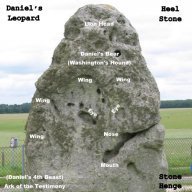
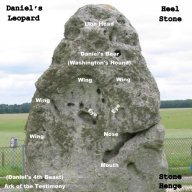
Shine on Harvest Moon Queen of Jungles (GMT) Geoff Wainwright, Archaeologist http://www.cardiffnetwork.cf.ac.uk/NetCommunity/Page.aspx?pid=344 Miranda Aldhouse-Green, Archaeologist http://www.cardiff.ac.uk/share/contactsandpeople/academicstaff/A-E/alhousegreen-miranda-prof-overview_new.html Timothy Darvill, Archaeologist http://www.bournemouth.ac.uk/applied-sciences/people/staff/tdarvill.html But thou, O Daniel, Heelstone Lion (cat), Stonehenge Panthera is a genus of the family Felidae (cats), which contains 4 well-known living species: the tiger, the lion, the jaguar, and the leopard. The genus comprises about half of the Pantherinae subfamily, the big cats. The word panther, while technically referring to all members of the genus, is commonly used to specifically designate the black panther. Only the 4 Panthera cat species have the anatomical structure that enables them to roar. http://www.panoramio.com/photo/58456079 Heelstone Bear (dog), Stonehenge Amphicyonids, often referred to as "Bear-dogs", crossed from Europe to North America during the Miocene epoch and are considered an Old World taxon. Bears are mammals classified as caniforms, or dog-like carnivorans, quite larger than dogs. Gray wolves are all Canis lupus subspecies except 2, the domestic dog and dingo. Hounds (pointers) assist hunters by identifying the location of prey, but it is the Retriever who recovers the quarry. http://spreadia.com/update/189409765/Heelstone,_Stonehenge_-_Daniel's_Four_Beasts_(1656) Heelstone Leopard (cat), Stonehenge Pantheon, literally "a temple of all gods", or "common to all gods", is a set of all the gods of a particular polytheistic religion or mythology. Pantheon can also refer to a temple or sacred building explicitly dedicated to "all deities", avoiding the difficulty of giving an exhaustive list. The most famous such structure is the Pantheon of Rome, built in the year 27 B.C. That building was dedicated to "all gods" as a gesture to embrace syncretism. http://picasaweb.google.com/115277444656030344375/ProfilePhotos#5648571986516937218 Heelstone Gofer (you), Stonehenge September '11 autumnal equinox, on 23rd at 9:04 a.m. (UTC), best time for a warm Turcaud-Conrad universal magnetic reversal (TCUMR) cosmically, and for sparing anymore '10+1=11 and 11-3=8' concrete damage to the artifacts. Gofer wood, or Worm wood? Decisions, decisions. (relics West to East order: altar / ark / seat / ephod-girdle / breastplate / altar / candlestick / table). Best nights for Harvest Moon viewing are on September 11, 12, 13. http://www.eternalidol.com/wp-content/uploads/2011/07/DSCF4536.jpg Heelstone Gophers, Stonehenge "And at that time shall Michael stand up, the great prince which standeth for the children of thy people: and there shall be a time of trouble, such as never was since there was a nation even to that same time: and at that time thy people shall be delivered, every one that shall be found written in the book. And many of them that sleep in the dust of the earth shall awake, some to everlasting life, and some to shame and everlasting contempt". Mike Pitts, Archaeologist http://www.britarch.ac.uk/cba/staff/mikepitts Mike Heyworth, Archaeologist http://www.britarch.ac.uk/cba/staff/mikeheyworth Mike Parker Pearson, Archaeologist http://www.sheffield.ac.uk/archaeology/staff/parker.html "And they that be wise shall shine as the brightness of the firmament; and they that turn many to righteousness as the stars for ever and ever". Julian Richards, Archaeologist http://www.archaemedia.net/default.asp Ancient of Days (GMT) Wizard Merlin
-
Nancy Hanks Lincoln Wiltshire Foxhound Temples Malmesbury, Wiltshire County, and the surrounding area, have some astonishing links to the United States, especially when you consider both the town's size (Population: 4631), and rural location. Historically Malmesbury was a center for learning and home to Malmesbury Abbey. Once the site of an Iron Age fort, it is the oldest borough in England. 1. Penns of Pennsylvania – came originally from this district. The family lived in Minety in 1560 and one of the family members was Law Clerk of Malmesbury, who died about 1590. Some of the family are buried in Minety itself. Also one of the older buildings in Minety, a house called "The Mansells", was the home of the father of the famous William Penn. 2. Sir Lawrence Washington – one of Malmesbury's earlier and most respected members of parliament, Lawrence Washington resided in Garsden Manor. He is an ancestor of George Washington, the first US President, and is buried in Garsden Church. Of particular interest is his ownership of Stonehenge, Wiltshire County, for over five decades. 3. Nancy Hanks – the mother of Abraham Lincoln was a Malmesbury woman. Her family went on to America to settle. Abraham Lincoln got most of his looks from his mother's side, and some say also his drive and initiative. The Hanks, some of whom still reside in the area, are one of the oldest families in Malmesbury, dating back to the Saxon era. Nine miles (14 km) from Malmesbury towards Washington's Stonehenge is the 3rd century BC "Hound Lord" dog shrine: hall, hostel, shops, and priest's house; at Nettleton Shrub, Wiltshire County. After 69 AD it was dedicated to Apollo Cunomaglus for cult worship. Penns, Washingtons, and Hanks frequented the Wiltshire Foxhound Temples. http://tinyurl.com/4xbldms http://tinyurl.com/3vp2mgx Garry Denke